

-

Founded in 1996, we provide integrated "Industry 4.0" software and equipment solutions for manufacturing enterprises. We are committed to the R&D and manufacturing of intelligent, green, and user-friendly intelligent equipment, continuously promoting the deep integration of information technology and industrialization. -
-
Auxiliary material feeding system for rubber tires/rubber products
-
Automatic Batching System for Cables and Cable Polymer Materials
-
Centralized feeding system + automatic batching system for plastic polymer materials
-
Automatic batching and full-process control system for friction materials
-
Green and environmentally friendly equipment and online environmental monitoring system
Product
Serving global clients in industries such as friction materials, building materials, rigid foam boards, welding materials, magnetic materials, and lithium batteries, we provide intelligent and environmentally friendly automated batching systems (auxiliary equipment for internal mixers/kneaders, automatic batching systems for small materials/additives, automatic batching systems for polymer materials, and automatic batching systems for composite materials). -
-
Tailored solutions: We provide suitable technical solutions and personalized services throughout the process, based on each client's needs and circumstances, and we pay attention to clients' potential needs. -
Following the principles of "intelligent control, advanced technology, practical stability, simple operation, and convenient maintenance", with a "professional" spirit and a "focused" attitude, we closely combine the user's actual production and development goals. Through continuous innovation and improvement, we effectively solve the production and management problems that users care most about, achieving "user satisfaction, joint innovation, and common development". -
Through company-wide innovation and continuous improvement, we constantly enhance product cost-effectiveness and stability. We continuously increase R&D investment to improve technological advancement and capabilities. Through continuous improvement of service models, we enhance service quality. We firmly follow the path of "specialization" to become a global professional company.
Knowledge of automatic batching of magnetic materials - Magnetic material cognition
Published Time:
2022-04-20
Magnetic materials are closely related to our lives, from the most common refrigerator refrigeration to high-end maglev trains. So, let's take a look at this magical material! 1. Why do magnets have different magnetic properties? Matter is mainly composed of molecules, molecules are composed of atoms, and atoms are composed of atomic nuclei and electrons. Inside the atom, electrons revolve around and rotate the atomic nucleus, both of which produce magnetism. However, in most substances, the directions of electron motion are different and chaotic, and the magnetic effects cancel each other out. Therefore, most substances, under normal circumstances, do not seem to have magnetism.
Magnetic materials are closely related to our lives, from the most common refrigerator refrigeration to high-end maglev. So, let's take a look at this magical material!
1. Why do magnets have different magnetic properties?
Matter is mainly composed of molecules, molecules are composed of atoms, and atoms are composed of atomic nuclei and electrons. Inside the atom, electrons rotate and spin around the atomic nucleus, both of which produce magnetism. However, in most substances, the directions of electron motion are different and chaotic, and the magnetic effects cancel each other out. Therefore, most substances, under normal circumstances, do not seem to have magnetism.


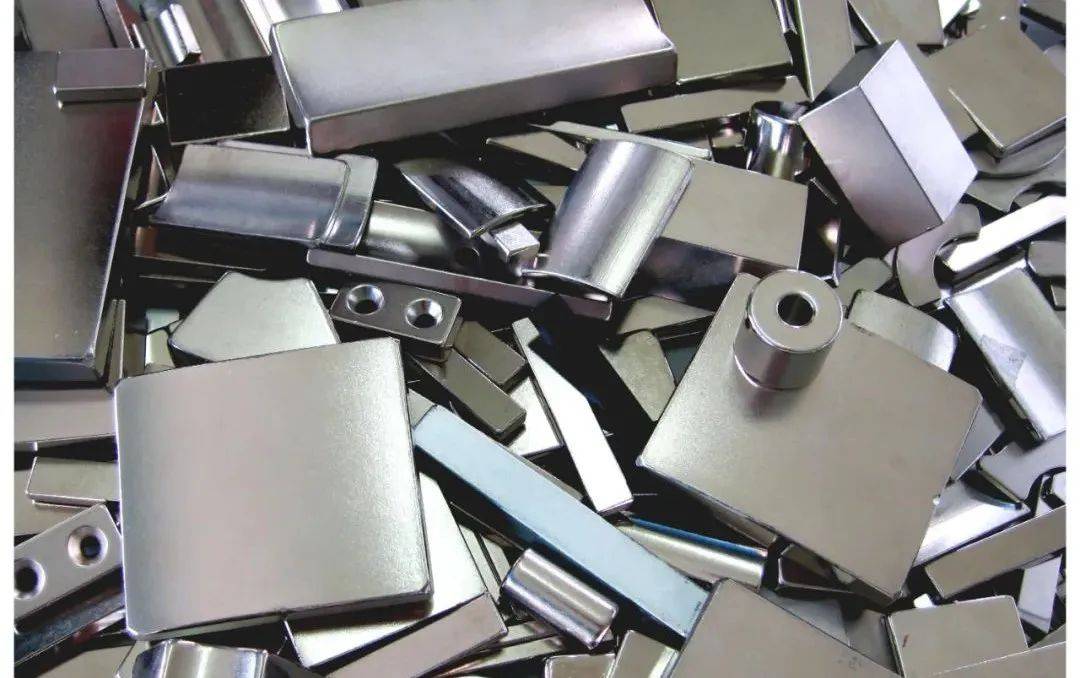
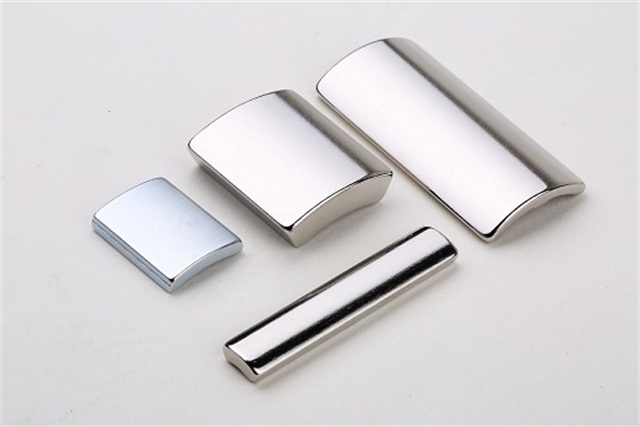
Ferromagnetic materials such as iron, cobalt, nickel, or ferrite are different. The electron spins inside them can spontaneously arrange themselves within a small range, forming a spontaneous magnetic field, called a magnetic domain. When a ferromagnetic substance is magnetized, the internal magnetic domains are neatly and uniformly arranged, increasing the magnetic intensity, forming a magnet. The magnetization process of a magnet is the magnetization process of an iron block. The magnetized iron block has an attraction between the different polarities of the magnet, and the iron block is firmly "attached" to the magnet.
2. How do you define the properties of a magnet?
There are three main performance parameters to determine the performance of a magnet.
Remanence Br: After a permanent magnet is magnetized to technical saturation and the external magnetic field is removed, the remaining Br is called the residual magnetic induction intensity.
Hc: The reverse magnetic field strength required to reduce the B of a magnetized permanent magnet from technical saturation to zero is called the coercive force, also known as the coercive force.
Magnetic energy product BH: Represents the magnetic energy density established by the magnet in the air gap space (the space between the two magnetic poles of the magnet), that is, the static magnetic energy per unit volume of the air gap.
3. How are metallic magnetic materials classified?
Metallic magnetic materials are divided into two categories: permanent magnetic materials and soft magnetic materials. Generally, materials with intrinsic coercive force greater than 0.8kA/m are called permanent magnetic materials, and materials with intrinsic coercive force less than 0.8kA/m are called soft magnetic materials.
Tags:
Beijing Mach Tiancheng Technology Co., Ltd.
Address: 12th Floor, Building B, Yu Hui Building, No. 73 Fucheng Road, Haidian District, Beijing
Telephone:86 010-88152355
Fax: 010-88133042
Email:xiayanqiu@machtech.com.cn