

-

Founded in 1996, we provide integrated "Industry 4.0" software and equipment solutions for manufacturing enterprises. We are committed to the R&D and manufacturing of intelligent, green, and user-friendly intelligent equipment, continuously promoting the deep integration of information technology and industrialization. -
-
Auxiliary material feeding system for rubber tires/rubber products
-
Automatic Batching System for Cables and Cable Polymer Materials
-
Centralized feeding system + automatic batching system for plastic polymer materials
-
Automatic batching and full-process control system for friction materials
-
Green and environmentally friendly equipment and online environmental monitoring system
Product
Serving global clients in industries such as friction materials, building materials, rigid foam boards, welding materials, magnetic materials, and lithium batteries, we provide intelligent and environmentally friendly automated batching systems (auxiliary equipment for internal mixers/kneaders, automatic batching systems for small materials/additives, automatic batching systems for polymer materials, and automatic batching systems for composite materials). -
-
Tailored solutions: We provide suitable technical solutions and personalized services throughout the process, based on each client's needs and circumstances, and we pay attention to clients' potential needs. -
Following the principles of "intelligent control, advanced technology, practical stability, simple operation, and convenient maintenance", with a "professional" spirit and a "focused" attitude, we closely combine the user's actual production and development goals. Through continuous innovation and improvement, we effectively solve the production and management problems that users care most about, achieving "user satisfaction, joint innovation, and common development". -
Through company-wide innovation and continuous improvement, we constantly enhance product cost-effectiveness and stability. We continuously increase R&D investment to improve technological advancement and capabilities. Through continuous improvement of service models, we enhance service quality. We firmly follow the path of "specialization" to become a global professional company.
How to solve the problem of PVC centralized material supply?
Published Time:
2022-05-27
Currently, as the proportion of labor and energy costs in the production costs of Chinese enterprises is increasing, and the impact of environmental pollution on healthy development, how can we improve the intelligent feeding level of PVC powder raw materials in PVC centralized feeding extrusion production lines?
Currently, as the proportion of labor and energy costs in the production costs of Chinese manufacturing enterprises is increasing, and the impact of environmental pollution on healthy development is also significant, how can we improve the intelligent feeding level of PVC powder raw materials in PVC centralized feeding extrusion production lines?
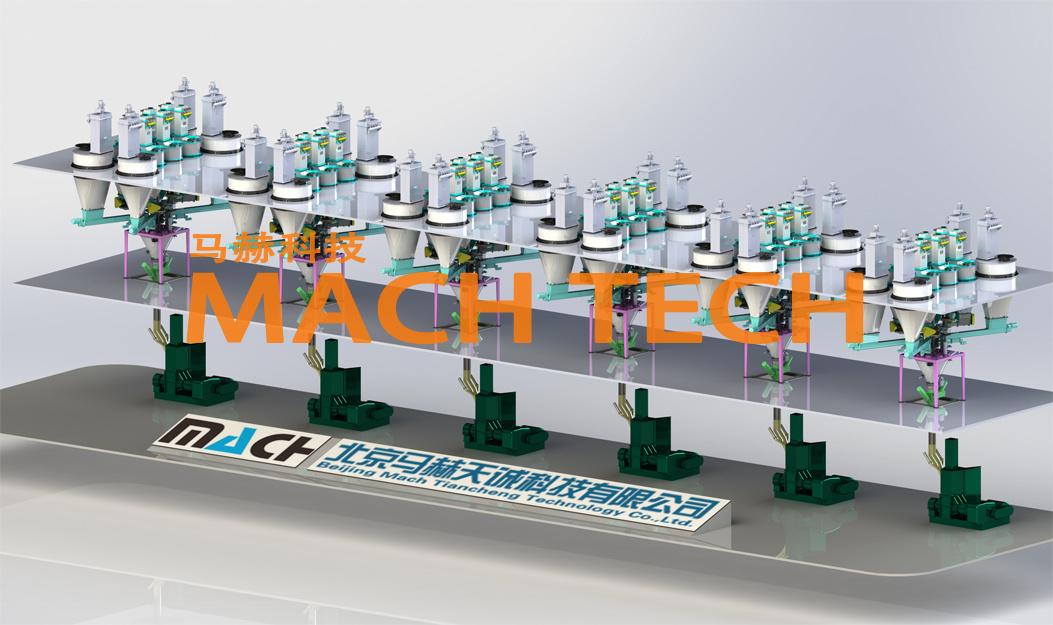
I. Existing Problems
1. The centralized conveying of PVC raw materials in the extruder hopper generally uses a tube chain or a spiral structure for long-distance transportation to the extruders of many enterprises. A high and low level switch is set on each extruder hopper. Once a shortage of materials is detected in a hopper, the conveyor is required to start feeding immediately, which leads to frequent starting and stopping of the conveyor, greatly affecting the stability of the equipment;
2. In addition, if one of the low-level switches fails, the extruder will not be able to shut down. If the high-level switch fails, the conveyor will be jammed due to continuous operation;
In traditional extruders, centralized feeding generally uses quantitative and parallel conveying methods. The PVC powder in the extrusion hopper varies greatly during consumption. During punching, "punching" and discontinuous punching (bridging) phenomena are prone to occur, causing the extruder screw to easily twist and break. More importantly, the uneven quantitative feeding of plastic products after extrusion molding leads to serious quality problems such as uneven wall thickness.
II. Technical Key Points
A programmable logic controller (PLC) is used to collect the starting and speed signals of the main motors of each extruder downstream of the entire tube chain. Then, the speed signals of each extruder are numerically calculated, and the required feeding amount for each production line is calculated based on the feeding amount. The feeding amount is then converted into the speed of the tube chain, and the speed of the tube chain is adjusted in real time to control the feeding amount of the extruder. In other words, when the speed of the downstream extrusion main motor suddenly increases or the operation amount of the extruder increases, the feeding system will immediately detect the change in speed and the increase in feeding amount, thereby increasing the feeding speed. Conversely, when the speed of the downstream extrusion main motor suddenly decreases or the operation amount of the extruder decreases, the feeding system correspondingly reduces the feeding speed, and the conveying speed of the tube chain also decreases accordingly. In addition, the feeding system also reads the current and torque parameters downstream of each extruder. When the extruder exceeds the torque alarm, the feeding system will automatically close the feed port of the corresponding tube chain conveying pipe of the extruder, stop the feeder, and not increase the feeding amount of the extruder, thereby reducing the output torque of the extruder and effectively protecting the extruder screw. In addition, it also has a unique redundant pressure relief mechanical design for flexible long-distance, multi-machine powder conveying to ensure that even if most hoppers are full of materials, the "scraper" powder pressure generated during the operation of the chain can be effectively released without leakage in special circumstances.
By collecting key data from all downstream extruders in real time, operating dynamically and continuously, and making timely adjustments, it can effectively solve a series of problems caused by traditional quantitative and intermittent feeding, such as "charging" and "blocking" of extruder hoppers, easy breakage of extruder screws, unstable extrusion of PVC extruders, and high failure rate of the centralized feeding system itself.
Tags:
Beijing Mach Tiancheng Technology Co., Ltd.
Address: 12th Floor, Building B, Yu Hui Building, No. 73 Fucheng Road, Haidian District, Beijing
Telephone:86 010-88152355
Fax: 010-88133042
Email:xiayanqiu@machtech.com.cn