

-

Founded in 1996, we provide integrated "Industry 4.0" software and equipment solutions for manufacturing enterprises. We are committed to the R&D and manufacturing of intelligent, green, and user-friendly intelligent equipment, continuously promoting the deep integration of information technology and industrialization. -
-
Auxiliary material feeding system for rubber tires/rubber products
-
Automatic Batching System for Cables and Cable Polymer Materials
-
Centralized feeding system + automatic batching system for plastic polymer materials
-
Automatic batching and full-process control system for friction materials
-
Green and environmentally friendly equipment and online environmental monitoring system
Product
Serving global clients in industries such as friction materials, building materials, rigid foam boards, welding materials, magnetic materials, and lithium batteries, we provide intelligent and environmentally friendly automated batching systems (auxiliary equipment for internal mixers/kneaders, automatic batching systems for small materials/additives, automatic batching systems for polymer materials, and automatic batching systems for composite materials). -
-
Tailored solutions: We provide suitable technical solutions and personalized services throughout the process, based on each client's needs and circumstances, and we pay attention to clients' potential needs. -
Following the principles of "intelligent control, advanced technology, practical stability, simple operation, and convenient maintenance", with a "professional" spirit and a "focused" attitude, we closely combine the user's actual production and development goals. Through continuous innovation and improvement, we effectively solve the production and management problems that users care most about, achieving "user satisfaction, joint innovation, and common development". -
Through company-wide innovation and continuous improvement, we constantly enhance product cost-effectiveness and stability. We continuously increase R&D investment to improve technological advancement and capabilities. Through continuous improvement of service models, we enhance service quality. We firmly follow the path of "specialization" to become a global professional company.
Industry prospects for automatic batching of refractory materials
Published Time:
2022-11-21
With the improvement of scientific research capabilities and the development of various modern technologies, the automatic batching of refractory materials has been further developed and improved. It allows for the rapid selection and transportation of dozens of materials according to the corresponding process formula. This mainly includes the following aspects:
Traditional refractory material production, while slow to transform and facing less environmental pressure, still maintains a semi-manual, semi-mechanized operation mode. This leads to high labor costs, generally low production capacity, low machine efficiency, and risks associated with improper operation. However, since 2017, in response to calls for addressing environmental issues, businesses that are environmentally unfriendly have been eliminated. This has resulted in significant losses not only in the refractory materials industry but also in traditional industries. At this time, forward-thinking individuals seized the opportunity to actively reform and integrate modern technology into the automatic control of the traditional refractory materials industry.
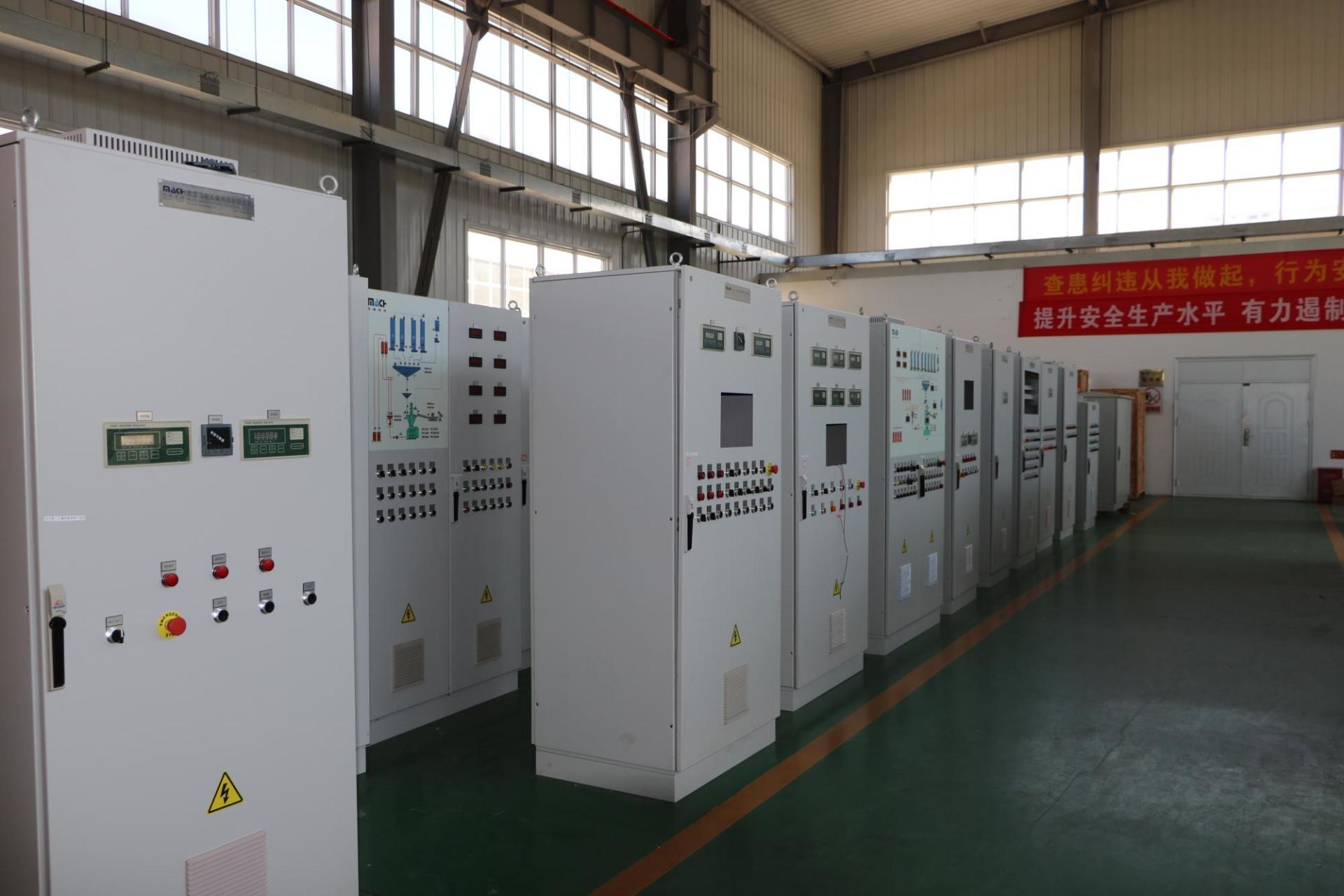
A complete automatic batching production line for refractory materials includes: feeding, crushing (grinding), screening, storage and transportation, batching, packaging, and palletizing. Of course, some lines may only include a few steps. Whether producing crushed stone particles or fine powder, dust generation is a challenging problem. In automated equipment production, core machines are equipped with dust removal and powder collection devices. This significantly reduces manual labor. A PLC control touch screen can be added to the system, or a desktop computer can be directly connected for convenient control. The new era is an era of technology. Supermarkets have already achieved unmanned operation. How far behind are factories?
With the improvement of scientific research capabilities and the development of various modern technologies, the automatic batching of refractory materials has been further developed and improved. For dozens of materials, according to the corresponding process formula, it quickly selects materials and transports them. This mainly includes the following aspects:
1. Distributed: Intelligent weighing and batching units are widely used, and the on-site unit measurement and control functions are gradually improved, forming a distributed structure system. The reliability of automatic batching of refractory materials is greatly improved, and the computer is relieved of heavy measurement and control tasks, focusing on data processing and batching optimization.
2. Intelligent: The automatic batching of refractory materials adopts more new concepts and technologies, and its functions are further improved. Sharing information with management information and laboratory information can provide various statistical data for management, automatically optimize the batching ratio and quantity, and achieve intelligent batching.
3. Reliability: The high integration and simplicity of the circuit greatly reduce the probability of failures, reduce daily maintenance, and shorten downtime;
4. High Precision: The adoption of new sensors, scientific scale structures, high-precision AD conversion modules, and other high-precision components effectively improves the overall measurement accuracy;
With the continuous progress of society and the rapid development of industry, and with the increasing market competitiveness, the development of automatic batching of refractory materials also faces opportunities and challenges. In the face of fierce competition, to achieve significant progress, self-improvement is necessary. An effective way to gain competitiveness is to improve accuracy, reduce production costs, and achieve a double increase in quality and quantity.
Tags:
Beijing Mach Tiancheng Technology Co., Ltd.
Address: 12th Floor, Building B, Yu Hui Building, No. 73 Fucheng Road, Haidian District, Beijing
Telephone:86 010-88152355
Fax: 010-88133042
Email:xiayanqiu@machtech.com.cn