

-

Founded in 1996, we provide integrated "Industry 4.0" software and equipment solutions for manufacturing enterprises. We are committed to the R&D and manufacturing of intelligent, green, and user-friendly intelligent equipment, continuously promoting the deep integration of information technology and industrialization. -
-
Auxiliary material feeding system for rubber tires/rubber products
-
Automatic Batching System for Cables and Cable Polymer Materials
-
Centralized feeding system + automatic batching system for plastic polymer materials
-
Automatic batching and full-process control system for friction materials
-
Green and environmentally friendly equipment and online environmental monitoring system
Product
Serving global clients in industries such as friction materials, building materials, rigid foam boards, welding materials, magnetic materials, and lithium batteries, we provide intelligent and environmentally friendly automated batching systems (auxiliary equipment for internal mixers/kneaders, automatic batching systems for small materials/additives, automatic batching systems for polymer materials, and automatic batching systems for composite materials). -
-
Tailored solutions: We provide suitable technical solutions and personalized services throughout the process, based on each client's needs and circumstances, and we pay attention to clients' potential needs. -
Following the principles of "intelligent control, advanced technology, practical stability, simple operation, and convenient maintenance", with a "professional" spirit and a "focused" attitude, we closely combine the user's actual production and development goals. Through continuous innovation and improvement, we effectively solve the production and management problems that users care most about, achieving "user satisfaction, joint innovation, and common development". -
Through company-wide innovation and continuous improvement, we constantly enhance product cost-effectiveness and stability. We continuously increase R&D investment to improve technological advancement and capabilities. Through continuous improvement of service models, we enhance service quality. We firmly follow the path of "specialization" to become a global professional company.
- Product Description
-
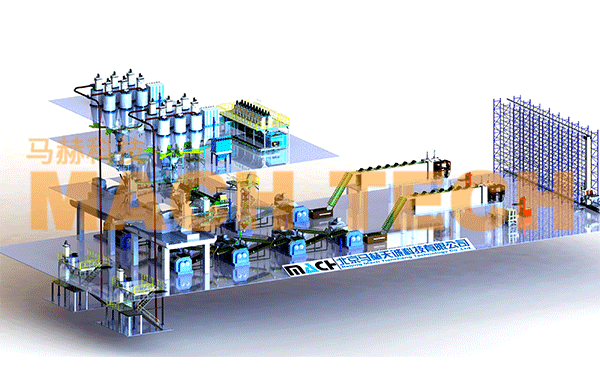
Low-temperature one-step rubber compounding system
1. The compounding rubber uses a one-step mixing method, which can improve the mechanical shearing efficiency of the rubber, making the carbon black and various compounding agents more evenly dispersed. This effectively avoids the formation of carbon black gel during the rubber mixing process, reduces the occurrence of irreversible chemical cracking of rubber molecular chains, increases the number of reversible mechanically sheared molecular chains, improves the tensile strength, wear resistance, and fatigue resistance of the rubber, reduces the Mooney viscosity, and other physical properties, improving the quality of the compounded rubber and products.
2. Using an open mill vulcanization system, the open mills are arranged in series and parallel to improve the sulfur dispersion effect;
3. Reduce the energy consumption of the traditional process using high-energy-consuming internal mixers for multi-stage mixing; save about 25% of electricity;
4. It also maximizes the production capacity of the internal mixer. The average number of sections of the compounded rubber is 1.6 sections, which means the production capacity is increased by 1.6 times;
5. Improve the automation level of the finishing line;
6. The quality of the rubber is uniform and stable;
7. Save manpower and management costs.
Low-temperature one-step rubber refining system
- Product Description
-
Low-temperature one-step rubber compounding system
1. The compounding rubber uses a one-step mixing method, which can improve the mechanical shearing efficiency of the rubber, making the carbon black and various compounding agents more evenly dispersed. This effectively avoids the formation of carbon black gel during the rubber mixing process, reduces the occurrence of irreversible chemical cracking of rubber molecular chains, increases the number of reversible mechanically sheared molecular chains, improves the tensile strength, wear resistance, and fatigue resistance of the rubber, reduces the Mooney viscosity, and other physical properties, improving the quality of the compounded rubber and products.
2. Using an open mill vulcanization system, the open mills are arranged in series and parallel to improve the sulfur dispersion effect;
3. Reduce the energy consumption of the traditional process using high-energy-consuming internal mixers for multi-stage mixing; save about 25% of electricity;
4. It also maximizes the production capacity of the internal mixer. The average number of sections of the compounded rubber is 1.6 sections, which means the production capacity is increased by 1.6 times;
5. Improve the automation level of the finishing line;
6. The quality of the rubber is uniform and stable;
7. Save manpower and management costs.
Related Products


Product Inquiry
If you are interested in our products, please leave your email, and we will contact you as soon as possible, thank you!
Beijing Mach Tiancheng Technology Co., Ltd.
Address: 12th Floor, Building B, Yu Hui Building, No. 73 Fucheng Road, Haidian District, Beijing
Telephone:86 010-88152355
Fax: 010-88133042
Email:xiayanqiu@machtech.com.cn